

My First Engraving

Engraving of metal plates is more or less a dead artform. Yes, there are many many people that still practice it. Yes, it bears its influence in the forms of any banknote or passport in the world: that dizzying matrix of curved lines.
But as a ‘fine art’ medium, engraving is six feet under. By the 17th century, artists had started realising that they didn’t need to learn the profoundly physical process of cutting lines into a sheet of metal. They could just use chemistry to do the work for them. That’s what etching is: you cover a metal plate with a surface based on (simplifying) waxes and soot powder, which is hydrophobic. Then you scratch ever so delicately away the black surface and dunk the metal into the right type of acid. Then you take the plate with the lines cut into the surface, cover it in ink, wipe off what’s on the surface, and put it through a high pressure rolling press to force the ink onto damp paper.
With engraving however, you don’t use a little needle to scratch away your lines. You use a solid metal V shaped tool called a ‘burin’ that comes to a very sharp point, and has a circular wooden handle that fits in the palm. With this tool you dig into the metal directly and (try) to make neat, fluent lines.
Where engraving requires the strength and control to cut each line through the hard material, in etching one is really only selecting what should be cut. Etching then is a kind of art by remote control, it’s like dictating letters rather than writing them yourself. Or a more chronologically accurate metaphor. Etching is to engraving what the crossbow or arquebus is to the bow and arrow. Any old chump can pick up etching with the right setup, and achieve results which are about as good as their drawing skills.
Engraving is nothing like drawing. The difficulty curve starts from 0 whether you can only make stick men or your Albrecht Dürer. In fact, Dürer is a pretty good example of what makes engraving special and why it died a sad death. In his early career, Dürer took up the relatively new art form of engraving on metal plates. He had already more or less mastered drawing in a late-Gothic style at the age of 13.
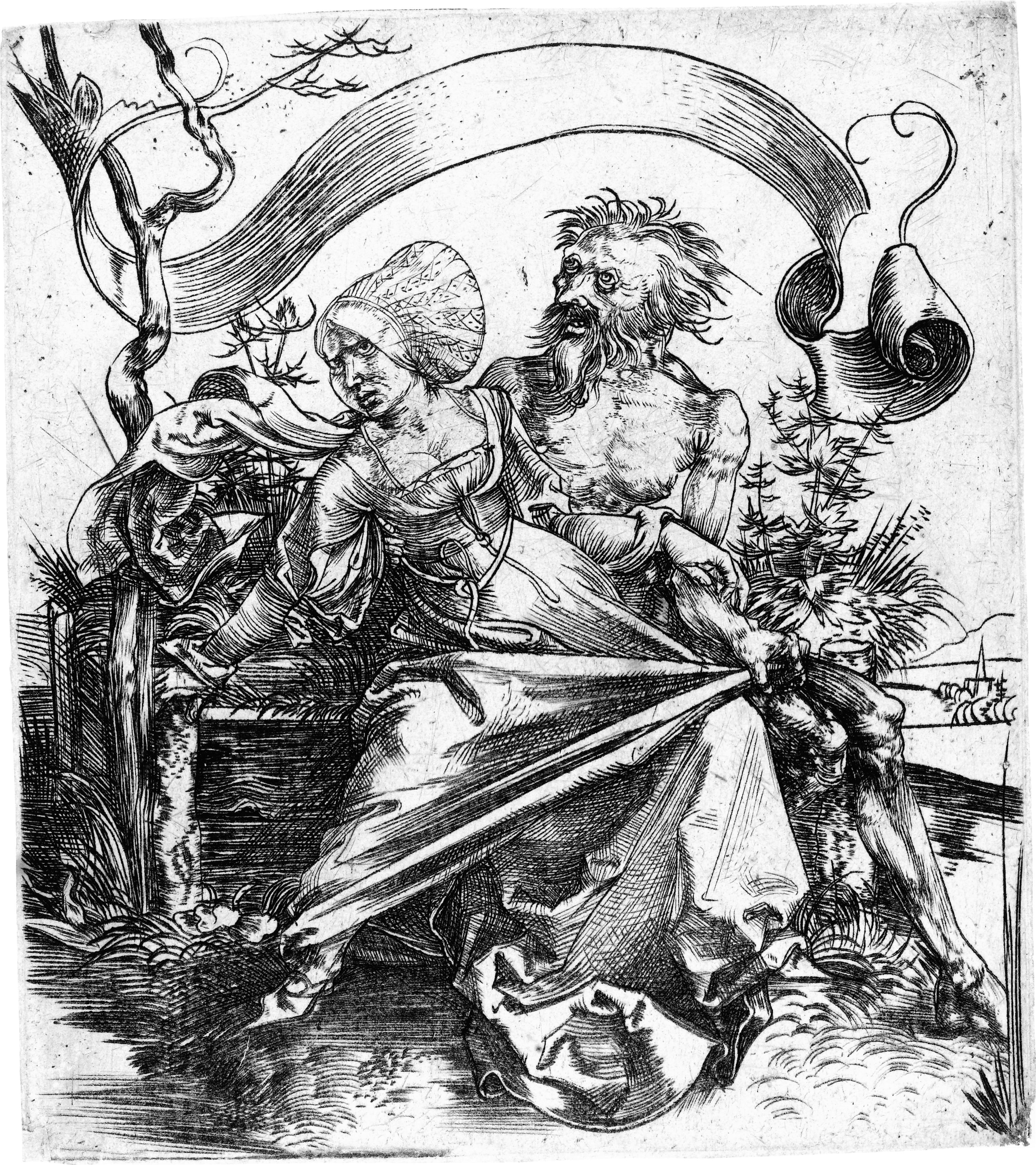
Some ten years later his first engravings appear (1495). Let’s take the hideous one called The Ravisher (it’s a metaphor for time). There’s no easy way of saying this, but the engraving is full of mistakes. Focus your attention on the big empty ‘banderole’ (banner) at the top of the image. You can see two tendrils coming off teh top right hand corner. One of them has this weirdly long straight section. That’s where Dürer, one of the greatest artists of all time (and specifically, one of the greatest graphic artists of all time) lost control of his tool.
The burin has slipped and shot across the surface of the plate. Then look at the shading of the banderole. The lines are supposed to be sinuous and smooth, but they run into each-other, probably because (like peeling an orange without breaking the skin), it’s really hard to keep going in a long smooth line because the more you continue, the more of a wire of metal you have coming out the other end of the tool. When you look further into the image you start seeing more and more lines that run off over the edges of whatever they are supposed to be shading in. In Time’s locks of hair that cling to his skull, there’s a line that skips right out of his head. There’s another one that juts out of the woman’s clothing on the left near the tree.
So about ten years ago I read about engraving techniques in my undergraduate degree. I understood in theory that it was really difficult, and started being able to recognise a technically good engraving from a bad one. But this is rather like saying you’re a world-class footballer because you have watched lots of football.
For years I’ve been desperate to know exactly how hard engraving is, what the medium does and doesn’t want to do. Every medium has a subtle pull towards a certain style, and typically in pre-modern art the artists worked as hard as possible to overturn that impetus. In modernist art the artists give in to that impetus, because giving-in is ‘honest’ to the medium. Thus woodcuts really want to be blocky and jagged and expressionist (which happened in the 20th century), but in the 16th century they were made to look like ultra-busy pen drawings.
Some time ago I tried to persuade the master printmaker who taught me etching and a few other techniques to show me how to do engraving. He said “you have to be one of two types of people to do engraving. Mad, or a masochist.” For both our sanity he gently suggested I do etching instead. So I did.
At the minute I live in Rome, so I started seeking out the appropriate madhouse where I could let loose my dark desire to understand the lost art of engraving, hoping that I wouldn’t slip and lacerate my left forearm in the process (this is not foreshadowing by the way, I was very careful).
I found my madhouse in the form of a really tiny print studio in a quiet corner of Trastevere, one of Rome’s especially touristy spots (it’s the Soho of Rome). The workshop was tiny, and had all the brown splatters of mysterious chemicals that give print workshops their unending charm.
We set to work. The first problem was that the master didn’t have many plates and asked if I had one with me. I did not. So she rooted around in her drawers and found a nice, very thin sheet of copper. We had to cut it in half, but the workshop that normally cuts plates to size for them was closed. So I had to literally drypoint the thing in half (by this I mean that I took a drypoint needle and repeatedly scored into the plate for about 10 minutes straight). It worked.
The next stage was preparing the plate’s edges and surface which was about the same as I had been taught for engraving but with some minor variations. The main variation was that the plate was pretty scuffed up, so I used some P1000 sandpaper (this grade feels like velvet!) to take them out. Then I used a white abrasive and cotton wool (I’m used to using jeweller’s rouge and brasso) to get it to a mirror finish. This is important because any residual ‘tooth’ in the plate will hold on to ink, so you’ll get ugly scratches.
Then we were ready to start cutting lines into the plate, but I had to transfer my design first. We used a kind of grease chalk on the inverse of my (photocopied, ironically) design and impressed it through. It produced an extremely faint image. This was a drawback of engraving that I had never imagined. Because there is no pitch black ground (and one that will take graphite or chalk), you have a copper coloured shiny surface that nothing really wants to stick to, because it’s metal. So the very first step is much harder.
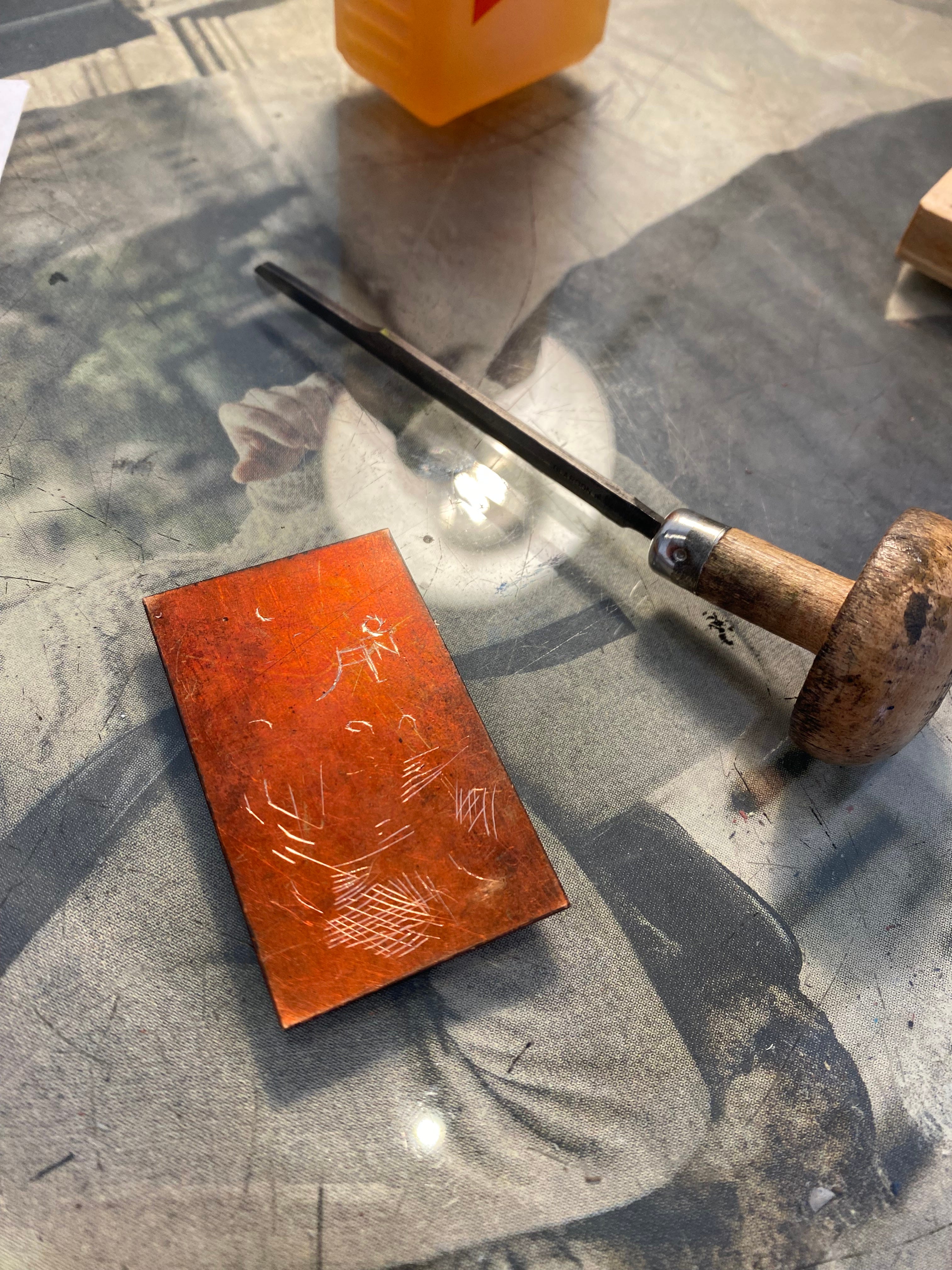
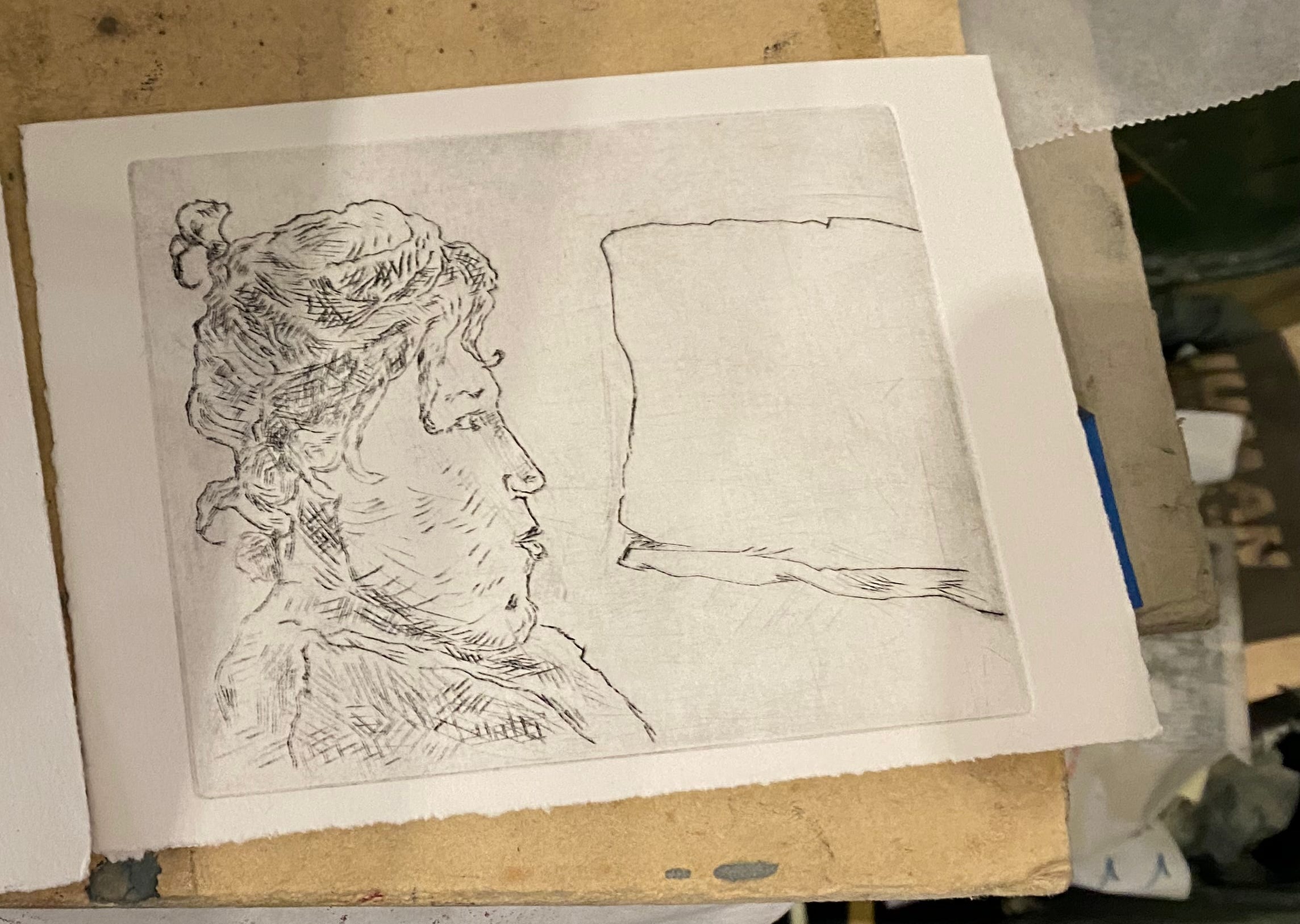
Then I set to work with the burin (cutting tool) after practicing a few lines.1 One of the few advantages of engraving compared to etching, but a fundamental one, is the fact that you can control the depth and width of lines, line by line. With etching, the acid doesn’t care about your designs so it’s all a matter of ‘cooking time’ in the liquid, and it’s all applied equally. You have to do several ‘baths’ in the acid to get a similar effect, and it really won’t look the same. Therefore I wanted to do some really deep lines that varied in weight as I went. I did this, but cut way, way, way too deep into the plate and threw up some massive burs on the sides of each line that I should have got rid of after each line. I didn’t. These printed as big blurry patches of dark ink when I made the first print.
Cutting deep into the plate in engraving is really hard. It’s physically hard, requiring strength, and it’s easy to screw up. So cutting gentle lines is easier, right? Right?
This is where I encountered the ‘slippage’ problem I mentioned in Durer. If you don’t go really deep into the metal, the burin you’re cutting with (also made of metal!) wants to slide across the top of the surface. So you lose control very easily indeed, and make these ultra-straight, light gouges into your printing surface. This can mean anything from giving someone half-meter long eyelashes to looking like they have a nail in their chest. Not ideal.
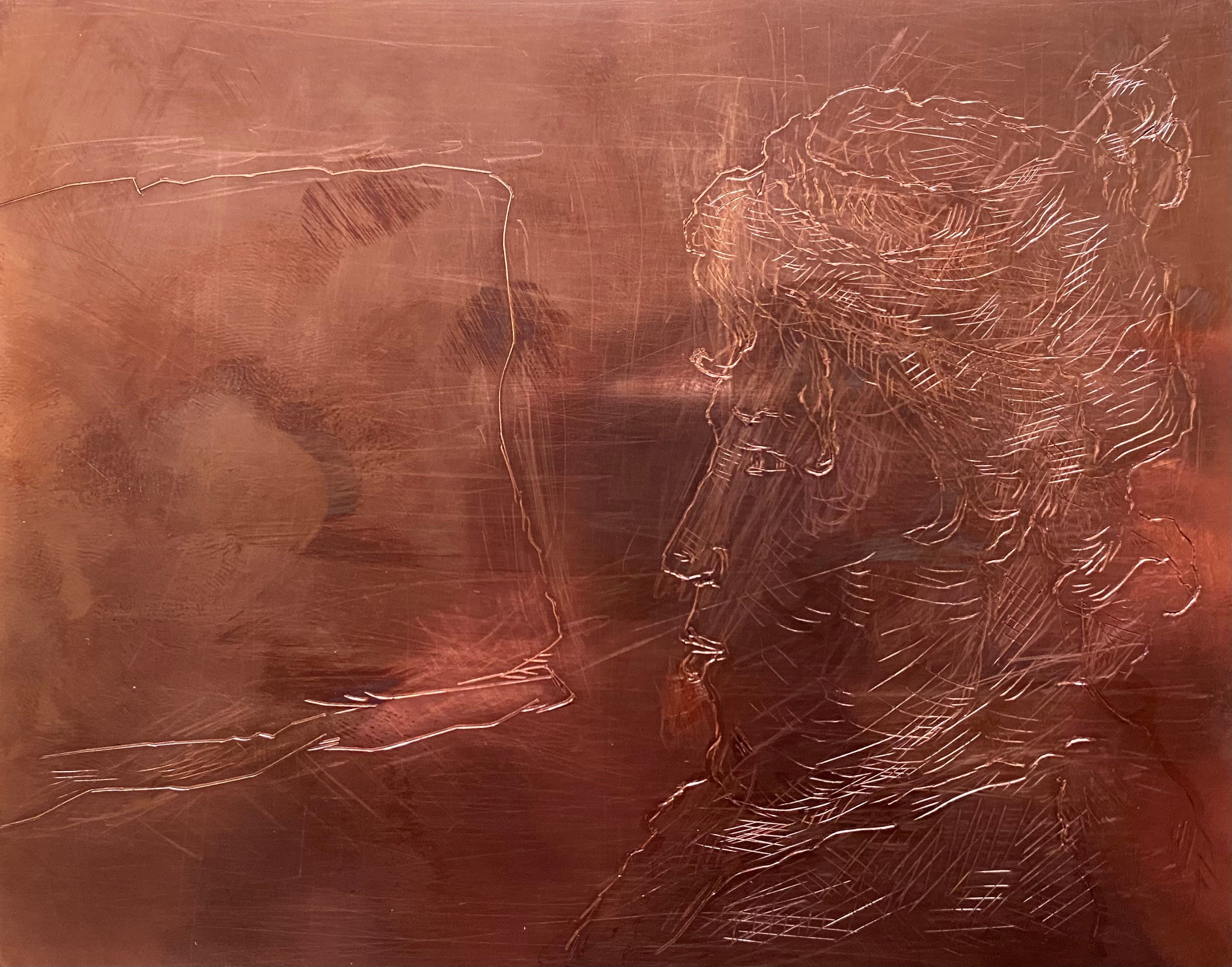
The final realisation in my learning-through-doing was that tight corners are really, really, really difficult. The burin absolutely does not want to do curves unless they’re circles with a huge centre. If, like me, you’re a zero-day engraver with a skill issue, the burin will make the circle on one side, but on the other side it will make these jagged sunburst shapes on the other. I think this is the far end of the cutting point (it’s a three dimensional tool after all) cutting into the back side of the curve. It looks bad. Have a look at my test plate to see what I mean.
To get a sense of what’s possible, now look at a couple of details from Hendrick Goltzius, my favourite engraver and possibly artist of all time.
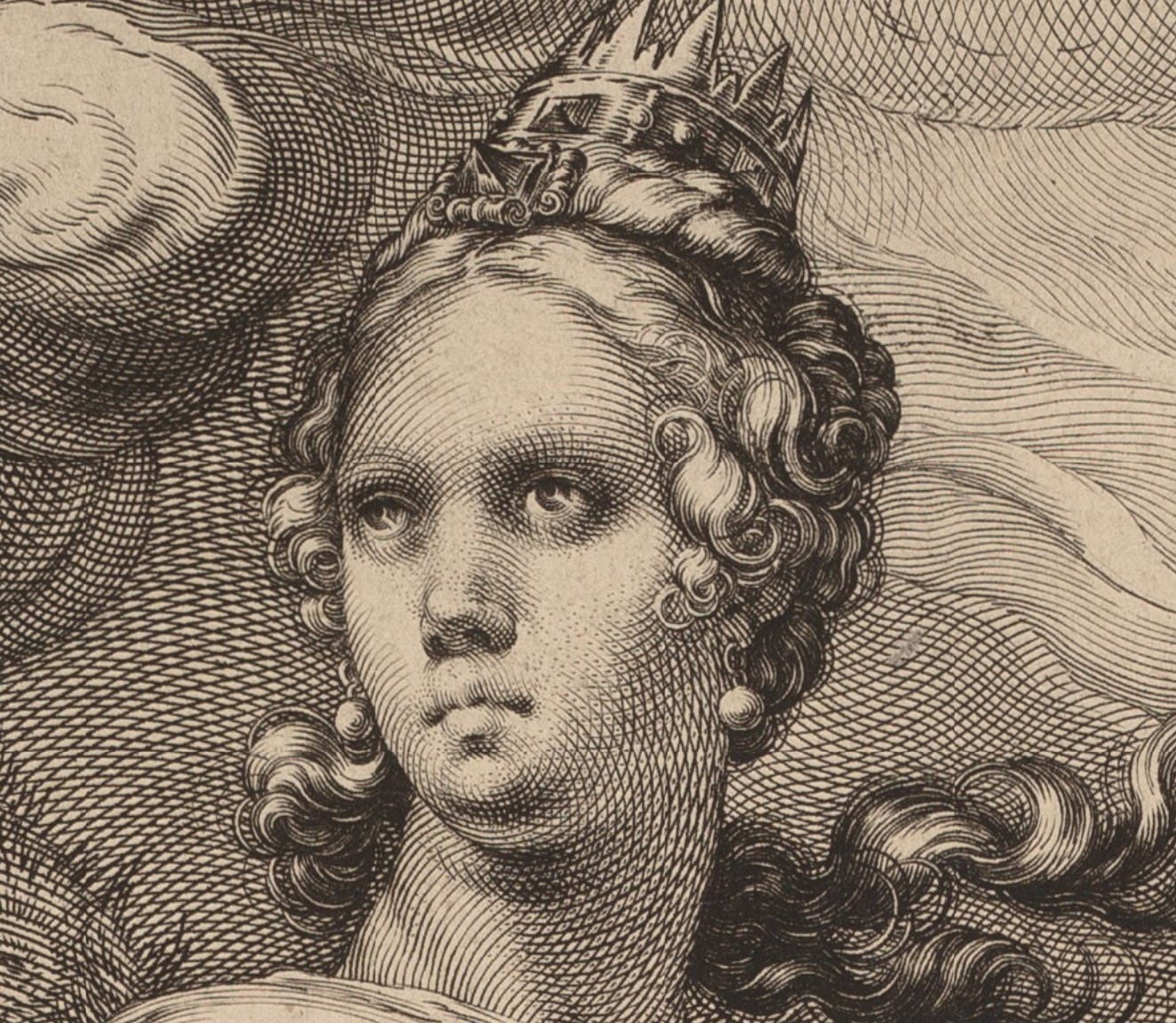
Look at the earrings. They are tiny spheres made of extremely tight circles. Earrings are almost everywhere in Goltzius’ engravings; just as weird unexplained spheres turn up all over the place in Dürer’s mature engravings. Now I know why. It’s a flex, as the kids say.
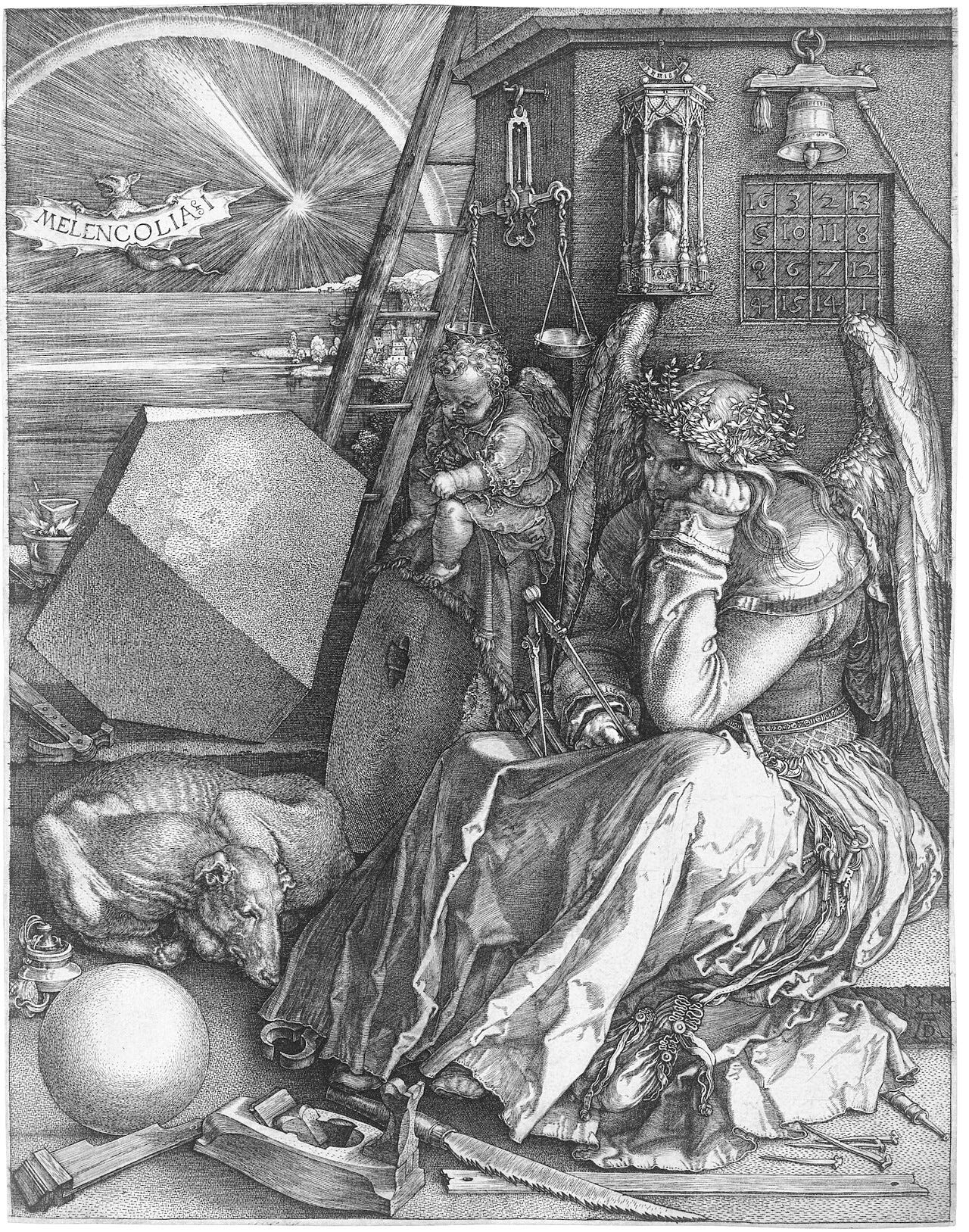
I am genuinely unsure how Goltzius did these. If you take a burin at a really high angle, you might reduce the length of the cutting blade in the plate and therefore avoid the jagged wheel effect. But if you do that, you need a lot of force to go into the plate and risk injury or a big slippage. So I’m not sure if that’s the trick, or it’s something about him being a master of sharpening the tool, which is also really difficult (see previous points about sharpening knives). Also note from this engraving how he is changing the line widths ever so subtly in the course of single lines), to describe the collageny-contours of Juno’s neck.
The act of skill that really hides in plain sight though are the inscriptions in Goltzius’ engravings. He uses a kind of mannerist/renaissance hand with curving, round ended serifs and, again, exaggerated differences between heavy and light line weights.
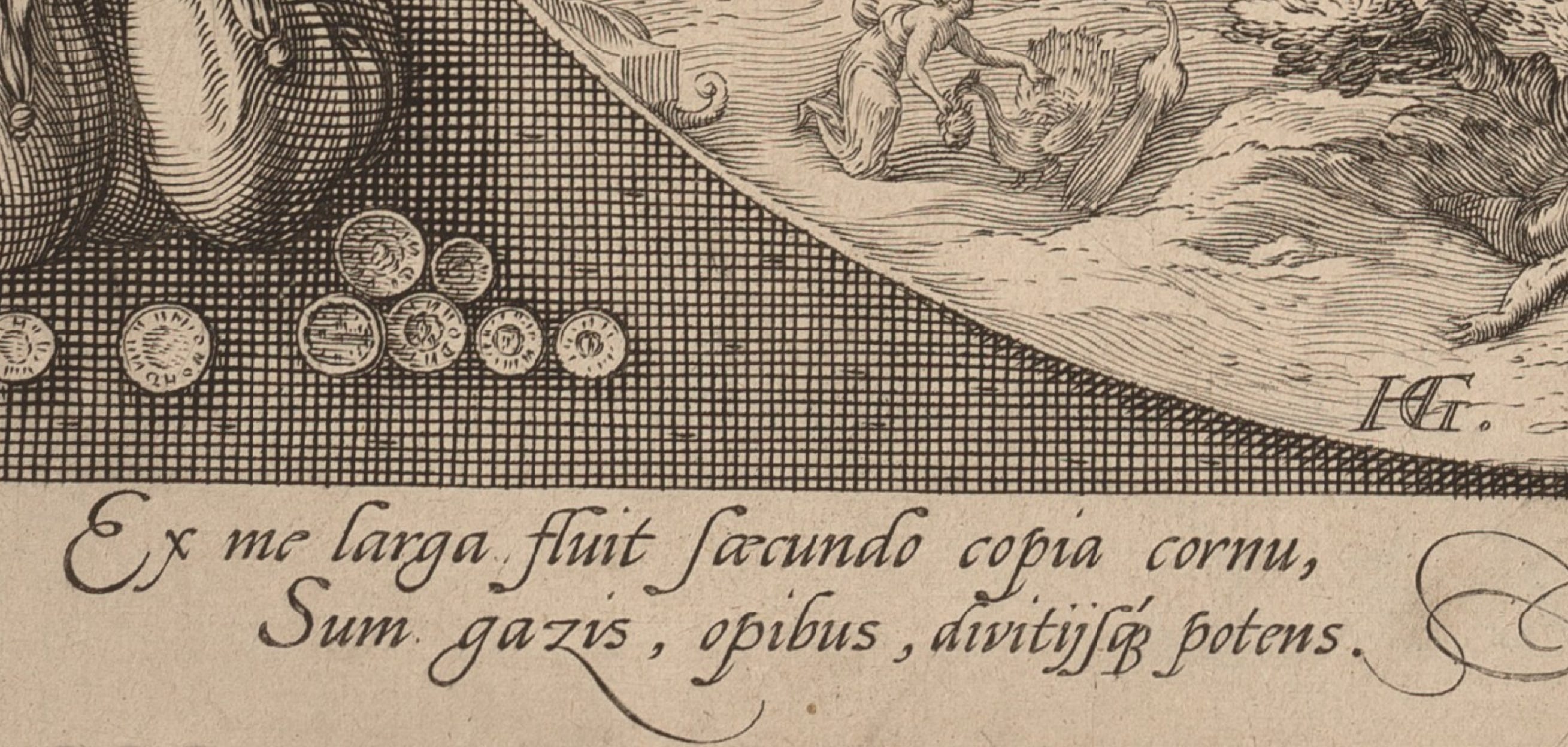
If you haven’t tried engraving, or have talked to someone who tries it, this just looks like text. But not ‘just’ text: it’s heroic.
These are all physical acts of artistry. It’s not the artist as philosopher, but the artist as footballer, ballerina, marksman. The morning I wrote this article, both my left and right arms were sore as though I had been doing weights the previous day. My left arm was sore from holding and turning the copper plate under tension, my right arm was sore from driving the metal thing into the other metal thing for about five hours.
At this point I should mention that Goltzius takes the ‘muscularity’ of the engraving technique and the Mannerist ideal of overcoming difficoltà to the max through his biography. As a very young child he severely burned his hand by falling into his parents’ hearth. The scar tissue fixed his dominant hand like so:2
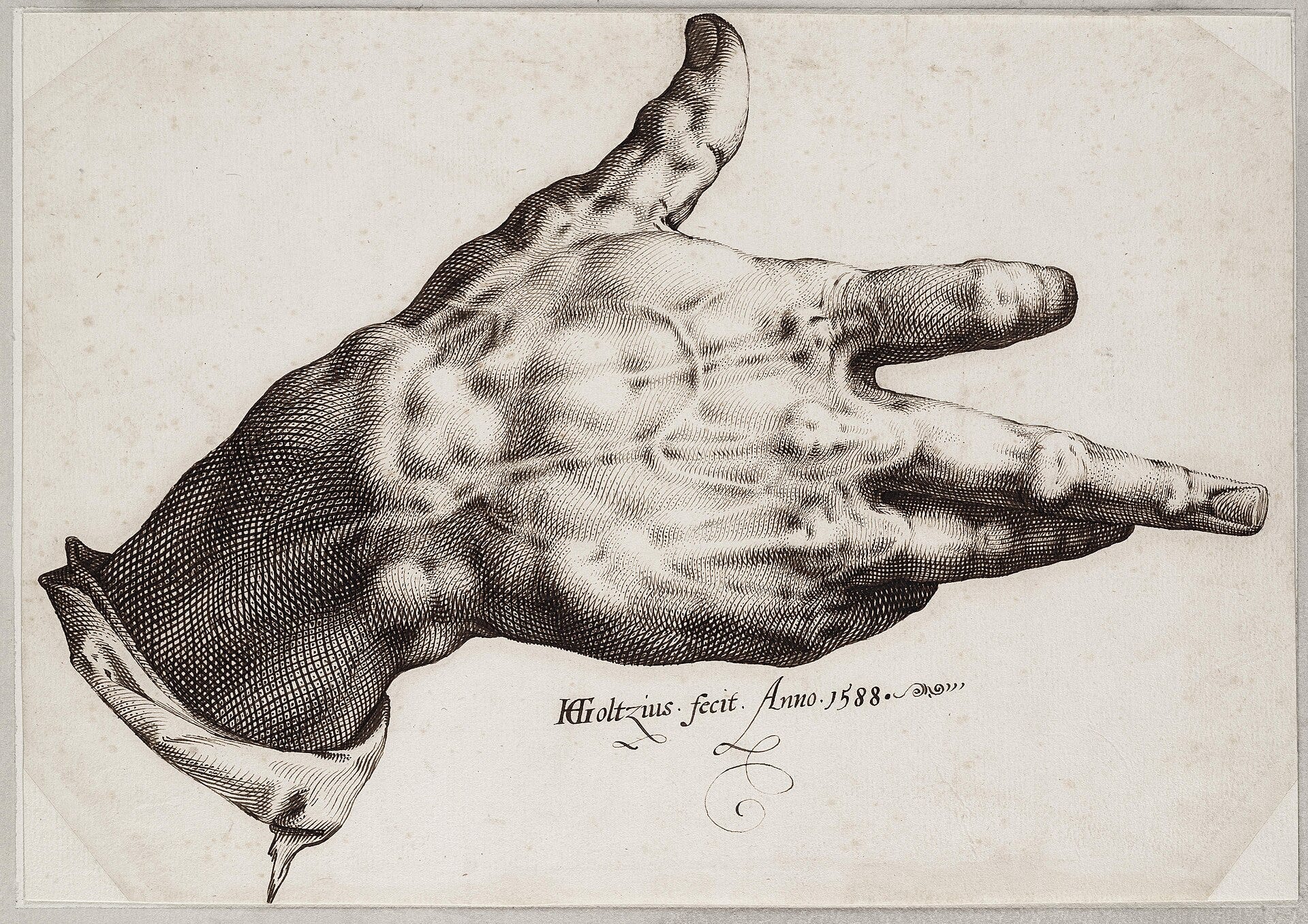
The artist made this part of his persona, and you can read about this in a very good recent article (that’s open access), here.
Precisely as expected, the process of trying engraving was a humbling experience. This was exactly what I wanted, and I’ll keep trying more to see if it gets any easier (it probably won’t without years of practice). There’s a ‘meta-level lesson’ here that I want to mention, too, though. Engraving has changed the way I think about art techniques in quite a major way.
There are some techniques that are just fundamentally resistant because of their literal, well, resistance. The copper plate is exactly that: it is not an extension of drawing, it is far harder than marble (i.e. in sculpture) and that is omnipresent when you try and do it. There’s really nothing, no style, no movement of the burin that comes easily. Engraving doesn’t have ‘openings’ to particular effects that the technique wants to ‘permit’. Sure, you can change line weights half way through in an engraving, but to be able to do so fluently requires, it seems, years of experience.
So masochism or madness really do capture the technique. I can’t wait to try again.
There is a bit of uncertainty as to whether this was Goltzius’ own hand. I am personally convinced that it is, because a) it had such an important place in his biography that he helped enhance; b) because the drawing (not an engraving) is made to an unbelievably high finish, is in extremely good condition which suggests that c) early in its life the drawing was considered a finished piece and therefore with a worthwhile subject: a self portrait. Finally d) this is a highly unusual pose for a hand even in the Mannerist age. If you have unimpaired hands like me, you will find this almost impossible and quite painful to replicate.
Really great read! I had a someone recently chastise me for not understanding etching, when I was talking about engraving all along, which was a little infuriating. Anyway.
So, from what I have read Dürer would place his plate on a sandbag whilst engraving. This would allow him to tilt the plate and the tool, achieving the very tight curls and circles and generally enable the 'nigri tortuosi tractus.' This, I imagine, will add a whole new dimension of pain, but may bring you a step closer.
Pretty good first try!